

Volume 30 Issue 4, Fall 2025
by Joe Coleman, Birding Coordinator

Joe Coleman has been leading birding walks almost since Loudoun Wildlife Conservancy began.
In 1995, Loudoun County’s population crossed the 100,000-person threshold. The Dulles Toll Road was close to completion, and development of the county was about to take off. Diane Gilliam (now Fetterman)had been meeting with some friends and neighbors about how to save the wildlife that still flourished in the county. On June7, 1995, the Loudoun Wildlife Conservancy held its first public meeting, at which Jocelyn Sladen gave a talk on how to create habitat for wildlife.
Recognizing that the greatest threat to wildlife worldwide is loss of healthy natural habitats, this small group of people wanted to find a way to protect what was so special in their community. As humankind expands its footprint and alters the face of the land, more and more habitat is lost. Sometimes that loss is obvious, as when we build a subdivision or a data center. Other times it is more subtle, as when we plant nonnative aggressive plants in our new yards or use pesticides to kill essential pollinating insects because we consider them a nuisance.
When those nonnative plants take over the natural areas that an enlightened developer has created (or left untouched) within a new community, they push out the native plants and the wildlife that depends on them. When we light up our houses and neighborhoods because we’re afraid of the dark, we alter the natural landscape and create a world where much less wildlife can survive, let alone thrive.

Summer nature campers embrace a tree.
This new organization, knowing that there was a lot of knowledge out there, partnered with several conservation organizations and began offering well-attended programs on a variety of conservation topics. This fledgling organization also decided that everything it did and everything it advocated for should be based on hard data and, to ensure that, the organization began a number of scientific monitoring programs that continue to this day.
Because we all need clean water to survive and recognize the importance of healthy streams and riparian habitats for wildlife, one of Loudoun Wildlife’s first initiatives was to work with other organizations to create a stream-monitoring program. In partnership with the Audubon Naturalist Society(now Nature Forward), the Loudoun Soil and Water Conservation District, and the North Fork Goose Creek Watershed, we received funding from the Chesapeake Bay Restoration Fund for a stream-monitoring program and began monitoring eight of the county’s 14 watersheds in 1998. We worked with the Loudoun Watershed Watch, one of our many partners, to do bacteria monitoring and plant riparian buffers in the Catoctin Watershed.

Volunteers monitor the health of a Loudoun stream. Photo by Sarah Ali.
We also partnered with the Waterford Foundation to plant thousands of trees and shrubs on the Phillips Farm and remove invasive plants there. Because healthy and extensive riparian buffers not only protect a stream’s health but also the wildlife that lives there, we planted several riparian buffers in that and other county watersheds. To this day, the large riparian buffer at Phillips Farm is still a place where wildlife and native plants thrive.
Today, Loudoun Wildlife has 28 benthic macroinvertebrate monitoring sites and, in partnership with the local Izaak Walton League of America, monitors the impact of road salt on our streams.
Loudoun Wildlife was still a very young organization in 1997, but it was a watershed year. We held our first butterfly and bird counts and took the lead in the campaign to make Banshee Reeks a nature preserve. This campaign really took off in 1998 as the county debated what the best use of the property was. In the press and over the phone, we succeeded in rallying Loudoun’s citizens to convince the Board of Supervisors that Banshee Reeks should be kept natural. Finally, on April 21, 1999, the Board of Supervisors voted to establish the Banshee Reeks Nature Preserve.
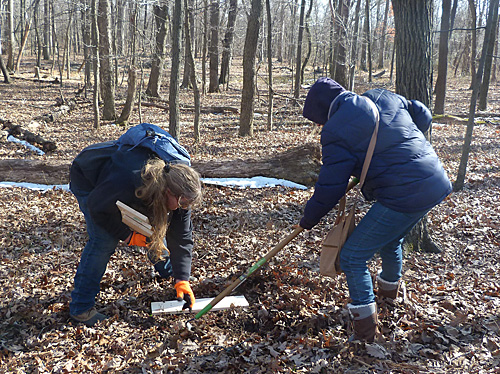
Volunteers place salamander boards at JK Black Oak Wildlife Sanctuary. Photo by Sheila Ferguson
In spite of their importance to amphibians and many other kinds of wildlife, vernal pools are a type of wetlands that are rarely protected because of their ephemeral nature (most only have water from late autumn through early spring). Recognizing their importance to wildlife, we made them a focus for Loudoun Wildlife during the winter of 1998-1999, and they are still a focus today. In 2006, Loudoun Wildlife began an Amphibian Monitoring Program that continues.
At the same time, we became aware of the importance of the limestone karst geology of the area around Lucketts to salamanders, frogs, and a variety of other wildlife. We learned of the globally rare wetlands on the Lee Family Farm between Route 15 and Montressor Road and, with our partners, worked with the family to have conservation easements placed on their farm.
As a result of our amphibian monitoring, we learned of an 87-acre property with globally rare wetlands about a mile north of the Lee farm. In 2020 we took ownership of it, and today it is our very own nature preserve, the JK Black Oak Wildlife Sanctuary, also protected forever by conservation easements. We have worked extensively to protect and enhance the habitat there.
Almost from our inception, we partnered with the Piedmont Environmental Council on a nature camp for children at Banshee Reeks. We began offering more youth programs in the mid-2000s.We supported the Roger Tory Peterson Awards program in the Loudoun County Public School system and played an integral role in the creation of the Loudoun Environmental Education Council in 2007.
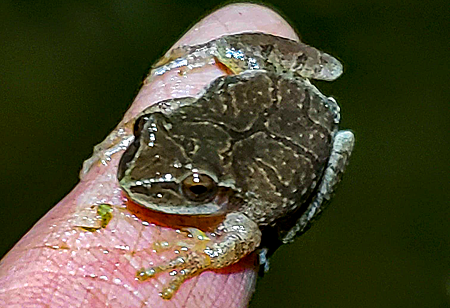
A Spring Peeper perches on a volunteer amphibian monitor’s finger. Photo by Jenny Erickson
Birding has always played an important role in Loudoun Wildlife’s activities. Not only have we held innumerable bird walks almost since we began, but our first Christmas Bird Count was held in 1997. As a result, today we have 30 years of data showing how avian populations have fared during that time period.
More significantly, from 2009 through early 2014, Spring Ligi coordinated the Birds of Loudoun Atlas Project. This study, which involved many volunteers, captured data on birds both nesting in and migrating through Loudoun County and culminated in the publication of Birds of Loudoun. Bird atlases on a county level are very uncommon, but capturing data for migratory birds is even less common. While healthy migratory stop-over locations are integral to the health of birds, they are often overlooked in studies of the habitat necessary for supporting healthy avian populations. As a result of our atlas, we know which areas in the county are of high value to birds and need to be preserved and protected.
Bluebird numbers are a testament to the importance of how increasing habitat can dramatically change the status of a species. In 2004, Loudoun Wildlife’s then-president, Nicole Hamilton (now Sudduth), began our bluebird trail program with 13 trails. Today, a team — comprised of Rich Wailes, Sharon Crowell, Sarah Flanagan, Lisa McKew, and Amelia Waring — leads a program with 63 trails and 753 nest boxes that fledged 1,595 Eastern Bluebirds, 1,099 Tree Swallows, 495 House Wrens, and 74 Carolina Chickadees in 2024. As a result of our extensive bluebird trail projects and education, bluebirds are again thriving and doing an incredible job of natural pest control in Loudoun County.
Our participation in the Annual Butterfly Count has also shown the importance of maintaining healthy habitats. Overall, we’ve seen a notable decline in butterflies as the county has developed, and climate change has had a greater impact on their populations. However, our backyard habitat programs, including the Wildlife Sanctuary Program, encourage people to plant and maintain habitats where butterflies can still thrive.
Through the efforts of our members, numerous volunteers, and staff, we have grown into the largest and most comprehensive environmental organization in Loudoun County as we have, for over 30 years, protected, preserved, and restored wildlife habitat.