• About Us
    • Mission & Vision
    • Board of Directors
    • Staff
    • Volunteer Program Coordinators
    • Our Partners
    • Contributing Photographers
  • Events
  • Our Work
    • Education
      • Programs and Field Trips
      • Nature-Based Learning: Peterson
      • Youth and Family Program
      • Habitat Herald
      • Eagle Cam at Dulles Wetlands
    • Community Science
      • Stream Monitoring
      • Butterfly Count
      • Amphibian Monitoring
      • Bluebird Monitoring
      • Bird Counts
    • Habitat Conservation
      • Habitat Restoration in the Community
      • Protecting Pollinators
      • Wildlife Sanctuary Program
      • Plant NoVA Natives
      • Native Plant Sales
      • Greening Your Neighborhood
    • Conservation Advocacy
      • Current Campaigns
      • Dark Skies
      • Past Campaigns
    • JK Black Oak Wildlife Sanctuary
      • Overview of JK Black Oak
      • What’s Happening
      • Vernal Pools
      • Flora and Fauna
      • Volunteers at Work
      • Support the Sanctuary
  • Store
  • Resources
  • Volunteer
    • Volunteer opportunities
    • Volunteer application
    • Waiver form
    • Volunteer hours
  • Contact
  • Stay Informed!
  • Join/Renew/Donate

Join/Donate

Stay Informed!
Loudoun Wildlife ConservancyLoudoun Wildlife Conservancy
  • About Us
    • Mission & Vision
    • Board of Directors
    • Staff
    • Volunteer Program Coordinators
    • Our Partners
    • Contributing Photographers
  • Events
  • Our Work
    • Education
      • Programs and Field Trips
      • Nature-Based Learning: Peterson
      • Youth and Family Program
      • Habitat Herald
      • Eagle Cam at Dulles Wetlands
    • Community Science
      • Stream Monitoring
      • Butterfly Count
      • Amphibian Monitoring
      • Bluebird Monitoring
      • Bird Counts
    • Habitat Conservation
      • Habitat Restoration in the Community
      • Protecting Pollinators
      • Wildlife Sanctuary Program
      • Plant NoVA Natives
      • Native Plant Sales
      • Greening Your Neighborhood
    • Conservation Advocacy
      • Current Campaigns
      • Dark Skies
      • Past Campaigns
    • JK Black Oak Wildlife Sanctuary
      • Overview of JK Black Oak
      • What’s Happening
      • Vernal Pools
      • Flora and Fauna
      • Volunteers at Work
      • Support the Sanctuary
  • Store
  • Resources
  • Volunteer
    • Volunteer opportunities
    • Volunteer application
    • Waiver form
    • Volunteer hours
  • Contact
  • Stay Informed!
  • Join/Renew/Donate

Stream Monitoring

New: 2025 Loudoun Streams Report Card Released

Loudoun’s streams earned a C+. Here’s how you can help improve that grade.

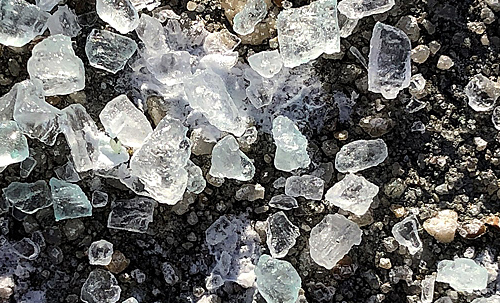
After analyzing over a year of monitoring data collected by 150+ dedicated community scientists contributing over 2,700 volunteer hours, the results are in: our county’s streams face serious challenges. Our newly released 2025 Loudoun Streams Report Card reveals that while water clarity scored an impressive A (92%), conductivity earned a failing F grade (15%) and road salt pollution scored a concerning C (46%). These low marks signal that runoff from development and winter road treatments is stressing our local waterways.

But there’s powerful reason for hope: every one of these challenges has a community-driven solution. The Report Card doesn’t just identify problems—it shows us exactly where to focus our efforts and invites you to be part of the answer.

English

Link to the English version of the 2025 Loudoun Streams Report Card

Español

Link to Spanish version of 2025 Loudoun Streams Report Card

Why Loudoun’s Streams Matter

Clean water isn’t just an environmental issue — it’s personal. The streams flowing through our woods, farms, neighborhoods, and parks are your drinking water source, wildlife habitat, and community assets – and impact our downstream neighbors from the Potomac to the Chesapeake Bay.

Our Monitoring Programs: Science in Action

Benthic Macroinvertebrate Monitoring

Stream Health from the Bottom Up

Since 1995, our volunteers have monitored benthic macroinvertebrates — the aquatic insects and small animals living on the stream bottom. These “macros” are nature’s water quality indicators and tell us the story of the health of our streams.

With 32 certified monitors and many additional volunteers, we will complete 50 biological surveys at 28 sites across the county in 2025. The Report Card’s biological monitoring score (C, 52%) tells us that pollution-tolerant species are becoming more common than sensitive ones—a clear warning sign that streams are under pressure.

Data is shared on the Clean Water Hub. See the map below for our Loudoun County area locations.

Watch benthic monitoring video| Learn more about our benthic monitoring

Salt Watch Program

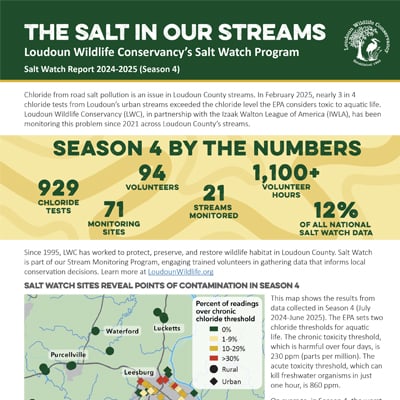
Launched in 2020 in partnership with the Izaak Walton League of America, Loudoun Wildlife’s Salt Watch program has grown from 9 volunteers at 14 sites to over 100 volunteers monitoring nearly 80 sites across 23 streams. Our program now contributes 15% of all nationwide Salt Watch data—making Loudoun a leader in tracking road salt pollution.

Volunteers test chloride levels at local streams twice monthly year-round and during winter weather events, helping identify salt pollution hotspots and advocate for smarter salt use.

All data is publicly shared on the Clean Water Hub. See the map above for more info.

Learn more about Salt Watch →

Chemical Monitoring Program

Digging deeper into water quality.

Launched in 2023 in partnership with the Alliance for the Chesapeake Bay, our “Chem Crew” of 13 dedicated volunteers conducts monthly monitoring at six sites along Tuscarora Creek and Town Branch in Leesburg—two urban streams showing concerning water quality trends. These measurements identify pollution sources and provide insights that benthic surveys alone cannot reveal—painting a complete picture of stream health that guides targeted restoration efforts.

Data is available on the Chesapeake Monitoring Cooperative Data Explorer (search by Water Quality Data and Group – Loudoun Wildlife Conservancy)

Watch chemical monitoring video

Securing Clean Drinking Water for Lucketts

Our monitoring data doesn’t just document problems—it drives solutions. When volunteers discovered alarming E. coli levels in streams near Lucketts in 2021, their findings triggered action that protected an entire community’s drinking water.

In 2022, Loudoun Wildlife Conservancy received a $41,432 grant to secure clean drinking water for the Lucketts community from the Tides Foundation, on the recommendation of the Google Data Centers Grants Fund. Loudoun Wildlife implemented a one-year comprehensive water quality testing program and public outreach events to promote awareness of, and provide services for, clean drinking water to the community.

Learn more about the Lucketts project

Get Involved

Our volunteers don’t just monitor streams—they shape policy, inspire students, empower people to take action to improve stream health, and build a community that values clean water.

If you would like to learn more about how you can get involved, contact our Stream Monitoring Program Coordinator Amy Ulland at aulland@loudounwildlife.org.

Stay Informed: Sign up for our newsletter, The Monitor | View online

Recognition & Impact

In 2023, our Stream Monitoring volunteers received the first-ever Environmental Excellence Award from Loudoun County’s Environmental Commission—recognition of the dedication that makes this work possible.
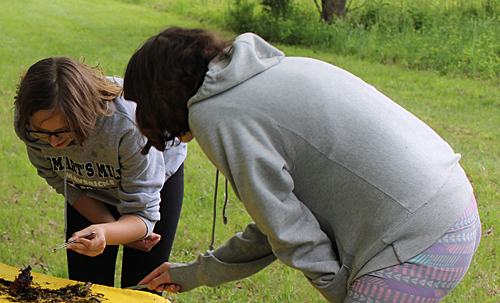

Volunteers xxamining macros

Benthic Macroinvertebrate Surveys

Clean water in a glass

Clean Drinking Water for Lucketts

Salt on road

Salt Watch

Our Work

  • DISCOVER: Education
    • Programs and Field Trips
    • Nature-Based Learning: Peterson
      • Peterson Young Naturalist Program
      • Resources for Educators
    • Youth and Family Program
    • Habitat Herald
    • Eagle Cam at Dulles Wetlands
  • EXPLORE: Community Science
    • Stream Monitoring
      • Benthic Macroinvertebrate Surveys
      • Clean Drinking Water for Lucketts
      • Salt Watch
    • Butterfly Count
    • Amphibian and Reptile Monitoring
    • Bluebird Trails/Nestbox Monitoring
    • Bird Counts:
      • Christmas Bird Count
      • Celebrate Birds/Birdathon
      • Young Birding Program
      • Bird Atlas
  • RESTORE: Habitat Conservation
    • Habitat Restoration In the Community
    • Protecting Pollinators
      • Native Bees
      • Bringing Back the Monarch
    • Wildlife Sanctuary Program
    • Plant NoVA Natives
    • Native Plant Sales
    • Greening Your Neighborhood
  • PROTECT: Conservation Advocacy
    • Current Campaigns
    • Dark Skies
    • Past Campaigns
  • PRESERVE: JK Black Oak Wildlife Sanctuary
    • Overview of JK Black Oak
    • What’s Happening
    • Vernal Pools
    • Flora and Fauna
    • Volunteers at Work
    • Support the Sanctuary
LOUDOUN'S GREAT PLACES

Community Science News

  • 12. Tuscarora Creek, IWL Park Site Description: This site is located at the Olde Izaak...
    Read More
  • 14. N Fork Catoctin Creek, Upstream Site Description: The North Fork of the Catoctin Creek feeds...
    Read More
  • 23. Town Branch, Harrison Street Site Description: This site is located just above the confluence...
    Read More

Contact Us

We're currently offline. Send us an email and we'll get back to you, asap.

Send Message
Join • Donate • Renew
  • About Us
  • Advocacy
  • Amphibian Monitoring
  • Annual Meeting
  • Celebrate Birds/Birdathon
  • Bird Counts
  • Bluebird Monitoring
  • Butterfly Count
  • Donate
  • Eagle Cam at Dulles Wetlands
  • Endowment
  • Habitat Herald Newsletters
  • Habitat Restoration
  • JK Black Oak Wildlife Sanctuary
  • Join Loudoun Wildlife
  • Loudoun’s Great Places
  • News & Events
  • Our Partners
  • Programs & Field Trips
  • Species Checklists
  • Stream Monitoring
  • Wildlife News
  • Wildlife Sanctuary Program
  • Young Birding Program

© 2025 Loudoun Wildlife Conservancy · PO Box 1892 Leesburg, VA 20177 · +1 (703) 777-2575 • Contact Us