

Volume 31 Issue 2, Spring 2026
by Abigail Seeley
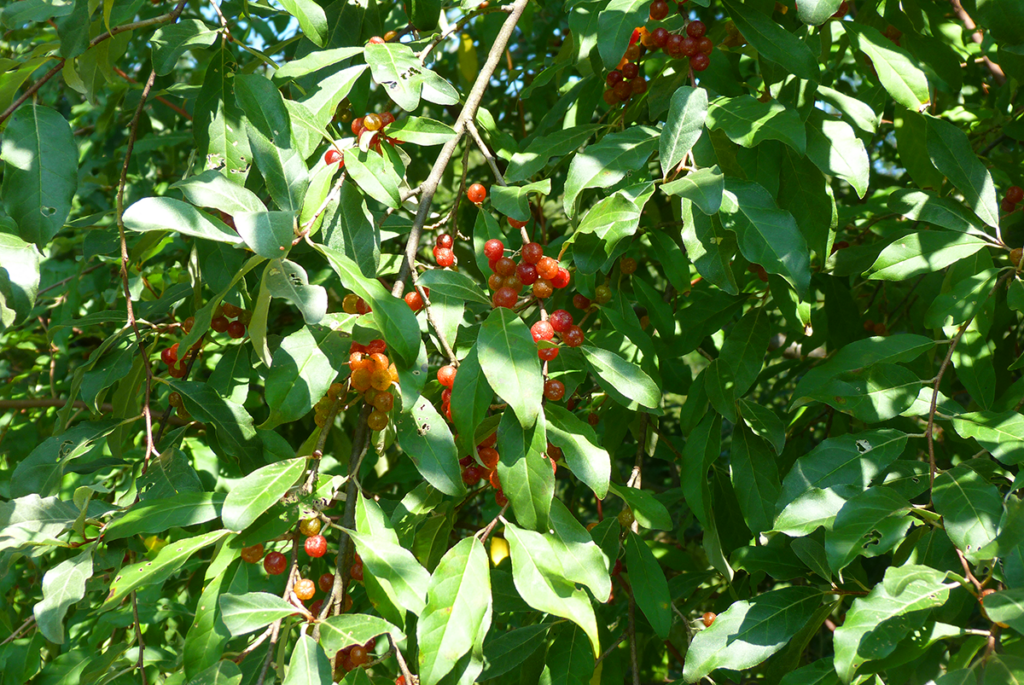
If someone is searching for Autumn Olive berries, most likely they intend to make jam. I am told that it is delicious, and a quick internet search yields recipes for jam, fruit leather, jelly, sorbet, and dressing. To make a tasty treat even better, Autumn Olive berries are extremely nutritious. These tangy, slightly sweet berries are high in vitamins A, C, E, and lycopene, a nutrient that helps to prevent cancer, decrease LDL (bad cholesterol), and decrease the risk of heart disease. Autumn Olive berries have almost three times more lycopene than the tomato. It’s quite a superberry!
Autumn Olive (Elaeagnus umbellata) was imported from Asia in the 1830s to be used as an ornamental landscape bush. It grows quickly, requires little maintenance, and has a pleasing, rounded shape in full sun. Its cream or light-yellow flowers fill the air with a sweet scent in the spring, and the birds and animals love the colorful berries that come in the fall.
It grows well in just about any soil (dry, moist, or sandy) and in any light, although it grows the biggest and most rapidly in sunny areas. With its easy growing habit and rapid reproduction, it became a popular plant for erosion control, forest restoration, strip mine reclamation, highway beautification, and in windbreaks and wildlife plots.
This raises the obvious question: If Autumn Olive is so good, why is it so bad? To begin with, it reproduces prolifically and in multiple ways:
• Birds spread the seeds as they consume the berries. A mature plant can produce about 30 pounds of fruit annually, which equates to about 3 pounds, or roughly 66,000 seeds.
• New bushes can sprout from the roots of an existing plant, growing out from the original plant’s root system in a circular shape.
• A plant’s branch lying in contact with the ground can take root as another bush.
A Formidable Foe
Autumn Olive also dominates its environment. It leafs out weeks before other vegetation in the woods and is the last to drop its leaves in the fall. That gives it more time, and inevitably more sunlight, to outgrow the native plants in the forest. In addition to these reproductive advantages, the plant has allelopathic properties, releasing chemicals into the soil that prevent the germination and growth of other plants. This further reduces the ability of native plants to survive under its canopy.
Autumn Olive can grow 20 feet tall and 30 feet wide, and its very dense habit makes it nearly impenetrable when leafing. At some stages of growth, the plant also has large thorns similar to those of the hawthorn tree. Tolerant of drought and poor soil, this plant’s fast growth allows it to establish dense thickets quickly.
For all these reasons, Autumn Olive quickly escaped the confines of its original plantings and began to spread across the U.S. Once you have learned to recognize it, you’ll find yourself noticing it everywhere. Watch for the silver undersides of the leaves that almost sparkle as they turn over in the breeze.
Autumn Olive is now ranked as a “severe threat” by numerous state agencies. In Virginia, it is labeled by the Virginia Department of Conservation and Recreation as a “highly invasive species” which “may disrupt ecosystem processes and cause major alterations in plant community composition and structure.” The U.S. Forest Service for the Virginia area lists Autumn Olive as a Category 1 weed — an “exotic plant species … known to be invasive and persistent [that] can spread into and persist in native plant communities and displace native plant species.”
My husband and I first met this beast in 2015, when we moved to our 12-acre property in Loudoun County. I had embraced the concept of a native landscape in our previous home, but this new home was so much more. More vegetation. A lot of plants I did not recognize. And woods! I had worked before with Audubon at Home, now called the Wildlife Sanctuary Program, and had gotten our last property certified. So we invited their ambassadors to the new property to help us understand what we had and where to go from there.
The amazing volunteers walked the property with us for several hours. In the end, they sent us a multi-page report of identifications, strengths, challenges, and recommendations. At the top of the list of challenges: “Autumn Olive has been planted in the past as an ornamental and is now dominating the woodland margin and continuing to spread.” We were looking at over 10 acres of forested land that had become dominated by Autumn Olive, in some parts even a monoculture.
A Lot to Learn
The first thing we learned is that Autumn Olive is very hardy and difficult to kill. Fire does not kill it, as the plant is able to regrow from its root crown. Cutting it down only causes it to regrow more densely. Just getting to the trunk to cut it is difficult because of the plant’s density.
So how did we keep from becoming overwhelmed by the enormity of this challenge? Triage and baby steps. We had already taken our first baby step in learning to recognize the plant. Our second step was to research methods to kill it.
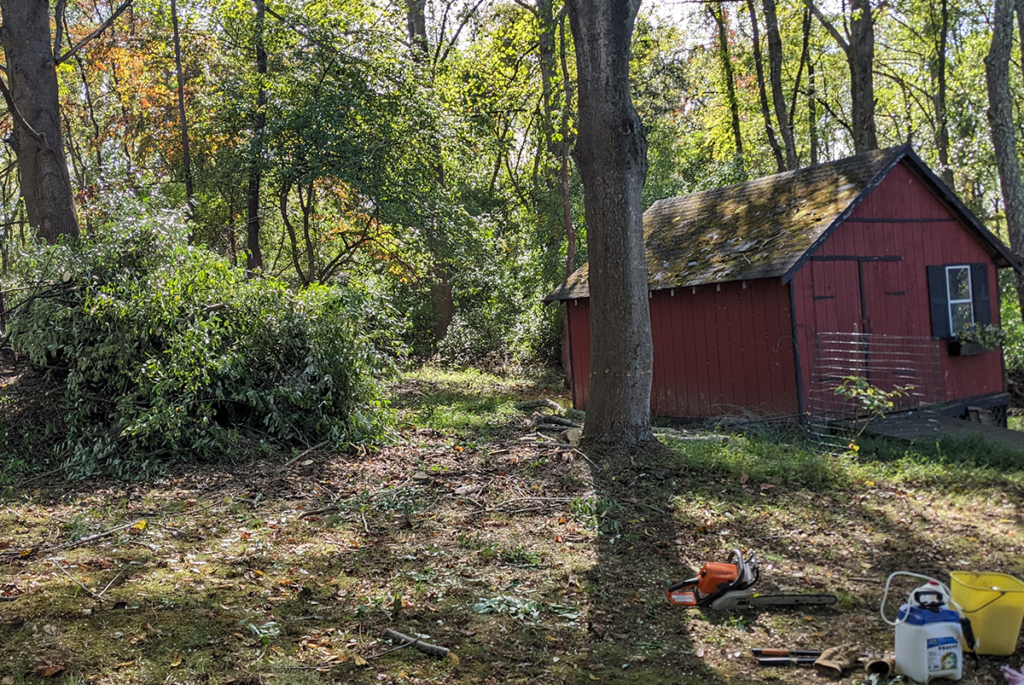
The most effective method that we’ve found to kill it is called the “cut stump” method. I start by cutting sections of the plant off from the top with loppers or a bow saw and work my way down. Otherwise, the canopy makes it nearly impossible to get to the trunk. Each cut piece is thrown on a nearby debris pile as I work. The debris piles act as vital habitat for small mammals, birds, amphibians, and insects, offering shelter, food, and protection from predators and harsh weather, while also enriching the soil with nutrients as the pile decomposes and helping to moderate soil temperature for new plant growth.
Once I get to the trunk, I cut it down close to the ground, leaving enough stump to spray. I immediately treat the stump with the herbicide glyphosate. I also wear protective gloves and long pants to cover my legs as instructed on the product label of the glyphosate. When applying the herbicide, I ensure that I cover the exposed areas of the stump completely but take care not to let it get on anything else. (Editor’s Note: Loudoun Wildlife does not support the use of herbicides as a general principle, but this focused, targeted treatment method is in line with Blue Ridge Prism’s recommendations and best practices when dealing with this incredibly tenacious invasive.
If a trunk is too large for the lopper blades (roughly 4 inches or less), then I will tackle it with the bow saw. Mostly, however, I leave the larger trunks for my husband to cut with a chainsaw. While he cuts, I haul the debris away to piles. I’m also the one who is watchful of native plants that we want to be careful not to injure. Once he cuts the Autumn Olive to ground level, I spray the stump.
Triage Helps!
I use triaging to decide where I will work. When I’m in the woods, I look for trees that are in danger of losing their crown to invasive vine growth — and for trees surrounded by dense clusters of Autumn Olive. As the Autumn Olive bushes spread from their roots, they may end up surrounding a tree. I’ve dubbed this the “Ring of Fire.” I imagine the toxins from the Autumn Olive are like a fire in the soil, burning the victim tree’s ability to get the nutrients it needs. Inevitably, the “Kiss of Death” will sprout — an Autumn Olive bush tucked right into the base of a tree. Such a tree doesn’t have much time left before it succumbs to the Autumn Olive’s invasive ways. These are the trees that guide me to where I’ll work.
The next step is to identify the block of time you have to devote to clearing (I typically spend about four to six hours a day for five days). Next, choose trees that mark off the four corners of the area that you feel you can reasonably clear. You want success, so don’t overestimate! At the end of the time you’ve allotted, pause and reflect on how much this area has improved. Take pictures. Drag someone out to admire it. Do something to mark your success. It’s crucial to avoiding burnout.
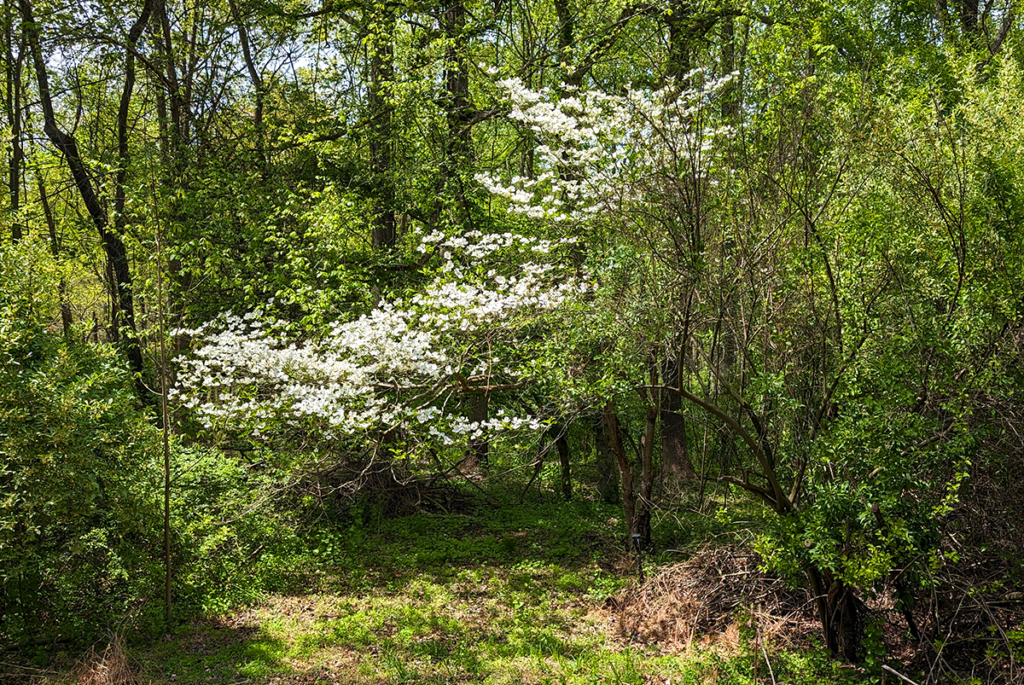
I will never forget one morning when I was looking out my back window. It was early spring and the dogwoods were in full bloom. At the edge of the woods, above the mass of Autumn Olive, was a spot of white. It was one lone branch from a dogwood with one blossom bunch, reaching out for sunlight. The rest of its branches had succumbed. That was a triage tree. I spent a week clearing the area, and I’m happy to report that now, several years later, that dogwood is thriving!
I encourage you to consider triaging if you, like us, face an unsurmountable forest to clear. Triaging has helped me maintain my motivation to get out there and keep working.
We are reaching the point where all our little pockets of work are starting to connect. One area unexpectedly came together for us in 2023: As we worked through the day, three different clearings from across multiple years began to connect. I had had no idea they were so close to each other when we began working. We put in a long day and got a cleared area about half an acre in size. It was a very pleasant surprise that I am still celebrating
The More You Know
You’re probably familiar with the term “Know your enemy.” This couldn’t be truer when trying to eradicate Autumn Olive. In the spring, it is literally the only thing with leaves. It’s the perfect time to identify those resprouts that have returned, because Autumn Olive is so good at regenerating. For several years after cutting and treating, you’ll need to watch for regrowth and quickly take care of it. Cut the growth with your loppers and give a spray to the exposed area of trunk. In the fall, when it is the last thing growing, it’s a good time to take out another area or two.
Albert Einstein said, “The more I learn, the more I realize how much I don’t know.” This is so true when doing conservation work. Keep learning, adjusting, and growing. Seek out others with a like mentality. Plan your work in baby steps, and triage. Most important, don’t forget to stop and enjoy what you have!
Abigail Seeley is a certified Wildlife Sanctuary property owner.
References:
Aamir Bhat, M.K. (2023). “Elaeagnus umbellata: A miraculous shrub with potent health-promoting benefits from Northwest Himalaya.” Saudi Journal of Biological Sciences, 30(6).
Anderson, D., Martin, C., & Hunt, J. (2022). Society for the Protection of New Hampshire Forests. Retrieved from “Something Wild: The Beauty of Brush Piles”.
D’Aurora, D. (2024). Penn State Extension. Retrieved from “Invasive Autumn and Russian Olives”.
The Nature Conservancy. (2024). Retrieved from “Autumn Olive: Your Invasive, Seedy Neighbor”.
USDA. (2023). Fire Effects Information System (FEIS).
Sources for Advice and/or Funding
• The Wildlife Sanctuary Program (a Northern Virginia Bird Alliance/Plant NOVA Natives/Loudoun Wildlife Conservancy partnership) offers information, on-site consultation, and recommendations to help
you establish and nurture sustainable natural habitat on your property — https://loudounwildlife.org/habitat-conservation/wildlife-sanctuary/
• Virginia Department of Forestry Community Foresters assist landowners in managing their forestland — https://dof.virginia.gov/forestmanagement-health/landowner-assistance/find-aforester/
• Invasive Plant Removal Grants offer guidance and funding to eligible landowners to promote and implement invasive plant removal projects — https://www.loudoun.gov/invasiveplants
• Loudoun County Soil and Water Tree Planting Grants are available to non-agricultural landowners in the county to plant trees with the goal of permanently reforesting currently non-wooded land — http://www.loudounsoilandwater.com/treeplanting/
• Blue Ridge PRISM provides site visits to identify invasives and create a management program for you at no charge — https://blueridgeprism.org/site-visits
• Capital Naturalist is a Facebook community filled with experts who can share their wisdom with you — https://www.facebook.com/groups/1428738304011660