

Volume 30 Issue 3, Summer 2025
by Tami Carlow
When I decided to go to grad school for entomology in the early 1990s, I needed to narrow down what I wanted to study and do research on. I decided to study weevils.
My first job was working in the weevil collection at the National Museum of Natural History in Washington, D.C. While there, I began to truly understand just how amazing and diverse weevils are. They range in size from 1.5 millimeters to 9 centimeters, and while mostly brown or black, they do come in many colors. They can be bumpy, smooth, wide, narrow, striped, spotted, and scaly.

A yellow poplar weevil (Odontopus calceatus) traverses a leaf. Photo by BJ Lecrone
Weevils, or superfamily Curculionoidea, are the most species-rich members of beetles — and the animal kingdom. With roughly 70,000 described species, they are incredibly widespread and diverse in their habits. They can be destructive pests, crucial ecological organisms, or just beautiful jewels and funky morphological wonders.
They are herbivores feeding on and inside leaves, on flowers, inside seed pods or stems, under bark, inside dead trees, and on underwater plants. They can be leaf rollers, gall formers, and root feeders. Some are flightless. Some weevils are only active at night — like some cactus weevils, Gerstaeckeria spp., or milkweed weevils, Rhyssomatus lineaticollis. It’s so exciting to head out at night with a headlamp to watch these night weevils in action. Most weevils blend in with their environment, aiming to look like seeds, or are camouflaged.
Weevil taxonomy is always changing. You can imagine how hard it is to classify such a varied group without many experts to work on them. Although roughly 70,000 species have been described worldwide, there are many specimens in insect collections in need of naming and describing.
Weevils are generally known as having a snout, called a rostrum, as well as elbowed antennae. Bark beetles or Scolytinae were once in their own family, Scolytidae, but were later placed into weevils. They have an extremely short rostrum. Broadnose weevils or Entiminae have a broad, short rostrum, while the rest of the weevils have a longer rostrum.
Acorn weevils have an extremely long rostrum with mandibles at the end adapted to drill into the hard shell of an acorn, where they will then lay one or two eggs inside the drilled hole. The antennae fit into grooves on the side of the rostrum as it drills deeply into the acorn. (See the acorn weevil in action.)
Some weevils are pests; for example, the cotton boll weevil, Anthonomus grandis, feeds and lays eggs on cotton bolls, seed pods, and flowers. It causes approximately $300 million worth of damage annually to cotton crops. Grain weevils, Sitophilus granarius, and rice weevils, Sitophilus oryzae, feed on various stored cereal grains, corn, and rice, and have now spread worldwide. The larvae eat inside the grain kernels, reducing the quality and value of the product, causing millions of dollars in damage annually.
Some other known pests are the non-native root weevils from Europe: Otiorhynchus ligusti, the Alfalfa snout beetle; Otiorhynchus ovatus, the strawberry root weevil; and Otiorhynchus sulcatus, the black vine weevil. Many more pests include the European snout beetle, sweet-clover weevil, clover root curculio, Asiatic oak weevil, carrot weevil, vegetable weevil, rhubarb curculio, pales weevil, white pine weevil, sweet potato weevil, rose curculio, pecan weevil, apple flea weevil, plum curculio, cabbage curculio, maize billbug, and the bluegrass billbug … just to name a few.
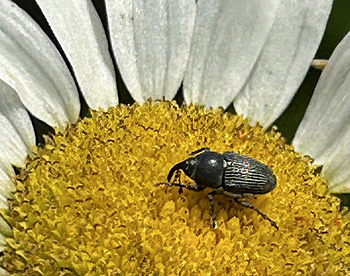
Odontocorynu salebrosus (no common name), a species of weevil, occurs in the United States and Canada. Photo by Tami Carlow
Of course, not all weevils are pests. In fact many weevils are host-specific and important pollinators of those particular hosts. Odontocorynus salebrosus feeds on the pollen of various asters and while doing so ends up aiding in the pollination of those plants by carrying some pollen on itself as it travels from flower to flower.
Some weevils are important because they are used for biological control of certain weeds and invasive species. The Asiatic invasive species known as Mile-a-Minute Weed forms dense mats that crowd out native plants. The host specific weevil Rhinoncomimus latipes — common name: the Mile-a-Minute weevil — was introduced in 2004 with some success against this aggressive weed. Similarly, the Melaleuca snout beetle, Oxiops vitiosa, native to Australia, was released in Florida to help control Melaleuca, an invasive woody plant.
Some weevils have large spines, like the four-spined weevil, Scolopterus tetracanthus. Some have beautiful iridescent colors, like the beautiful, fittingly named Eurhinus magnificus. Some weevils in the subfamily Conoderinae mimic flies to avoid predation, and in turn trick predators with their quick, flighty movements and fly-like coloring. (See video. Some have lots of hairs on their rostrums and are called bottle brush weevils, Rhinostomus barbirostris.).
Other weevils have fungus-like scales on their backs and blend in with the fungus on certain trees (Alcidodes spp.). Giraffe weevils, Trachelophorus giraffa, have long necks, are endemic to Madagascar, and are sexually dimorphic, with males having “necks” two to three times longer than the female. Some weevils are like tanks, with a thick, hard exoskeleton. Others, such as Pachyrhynchus spp. and Eupholus spp., have polka dots and stripes lining their backs.
Weevils are an incredibly diverse and interesting group of beetles. What we know about them is minimal, and it excites me to try and learn more and in turn educate others who are curious about weevils. I always enjoy answering questions, hopefully leading to a much needed appreciation of these wonderful creatures. To this day, I still get excited whenever I see a weevil.
Tami Carlow holds a degree in entomology from Cornell University.